Tuesday, April 12, 2011

What is Passover?

thedailygreen.com


What is Passover?

Have you ever wondered what Passover is and why it is celebrated and why it is so different from Easter?  Well I have found lots of great information on the topic.  I have to take the folks who already wrote all of this down for us.  You can find the web address of each site with the following information below.
Take some time to read all about Passover and also watch the video below of a Passover meal.  I promise you will be bless and you will learn lots of cool stuff you didn’t know before!

When is Passover this year? Passover in 2011 will start on Tuesday, the 19th of April 

 This website is a great resource for understanding why Christians should celebrate passover.

If you are not Jewish, there are certain things that just tend to offend the Gentile mind... things we do not understand.  Most of us have never celebrated Jewish feasts and certainly most of us have not understand or come close to appreciating the richness of the heritage we have been given spiritually by the Jewish people and from the Law of Moses itself.  As one Jewish teacher put it, if we celebrate holidays that have Pagan roots and assign spiritual significance to them (take Easter and Christmas for example), wouldn't it be more appropriate to celebrate the feasts and holidays that God gave His people?? It does make sense if you think about it... God's feasts probably hold a lot more symbolic meaning and depth of life than anything a good ole pagan could come up with...  I mean if we are going to roll around Easter eggs and put up Christmas trees (which I am not criticizing-- I can draw spiritual pictures of Messiah in both these exercises), then why can't we commemorate the very festivals that DIRECTLY point to the person, work, and ministry of Jesus??
Passover, for any Christian who has spent the time to actually study it, is the equivalent to the Easter holiday most of us celebrate.  There are three festivals or feasts or "rehearsals" of the LORD that are in view actually, as recorded and observed from Leviticus 23: Passover, Unleavened Bread, and Firstfruits.  If it is any wonder that Passover is around the same time of the year as Easter, that is because the "Last Supper" that Jesus (Yeshua) and His 12 disciples were celebrating was His last PASSOVER meal that He shared with them before his death, burial, and resurrection. This was actually a "memorial" meal as the rest of Israel would sacrifice their Passover lambs the following evening, the 14th of Nisan, consistent with when Jesus was being offered up on the cross. In 30 CE (or AD), Jesus was crucified on that Wednesday and buried before the "Sabbath" day that was observed as part of the feast of Passover, the following Thursday.
Now it was the Preparation Day of the Passover, and about the sixth hour. 

And he said to the Jews, "Behold your King!" 
 But they cried out, "Away with Him, away with Him! Crucify Him!" 
Pilate said to them, "Shall I crucify your King?" 
The chief priests answered, "We have no king but Caesar!"
Then he delivered Him to them to be crucified. So they took Jesus and led Him away.
  John 19:14-16

Easter commemorates the death and burial of the Lord Jesus, and as a remembrance of this event, Christians participate in what we call Communion or the Lord's Supper.  The "Lord's Supper" for most of us is taking of grape juice and a wafer... but the ORIGINAL Lord's Supper was the entire Passover meal.  The Passover looks back at the delivery of the Jewish people from the power of Pharaoh just as communion looks back at our delivery from the power of sin.  Many of us do not understand the significance of Communion because we have never participated in a Passover meal... the traditional Passover celebrated by Jews worldwide today is essentially the SAME meal that Jesus celebrated with the disciples on that fateful night.  What we know of as "Good Friday", is really more correctly "Good Wednesday" and what we know as the "Lord's Supper" is really the "Lord's Passover".
Why does the Passover matter so much? Why should it be that big of a deal?? We're not Jewish, so why do we need to celebrate a Jewish festival?  Friends, we may not be Jewish, but we are MESSIANIC... we are Messianic Gentiles just as those of our Jewish  brothers who have received Jesus as Messiah are Messianic Jews. Because of our faith in the Jewish Messiah, we need to hold dear the things that God held dear to them... the "Older" Testament was not "done away with" in Messiah... rather the Law was fulfilled completely so that we would not have to find our righteousness in it, but in the person the Law, the Writings, and the Prophets pointed to: Yeshua (see Luke 24:44).  To the degree that we understand our place in the olive tree, a wild branch grafted in, is the degree to which we will understand ALL that Jesus died to give us.  Let's take a quick look at why you should celebrate a Messianic Passover as part of your "Christian" experience.


Therefore purge out the old leaven, that you may be a new lump, since you truly are unleavened. 
For indeed Messiah, our Passover, was sacrificed for us. 1 Cor 5:7


What is all this talk about leaven and why is it linked to Passover?? Well, if we were Jewish, we would understand that for the period of days (and sometimes weeks) leading up to the Passover feast, the Jewish household would rid their house of ALL leaven (leaven is symbolic for sin).  This is a picture of our own self examination and our own putting away of idols and sin from our lives.  When the last bit of "leaven" was removed from the house and the final cleansing ceremony (known as Bedikat Hametz) was  performed, the Father of the house would make the pronouncement "God, our home has been purged of all leaven to the best of my knowledge and is now ready for your presence."  Does this shed any light on the Apostle Paul's instruction (who was a Jew of Jews himself):


But let a man examine himself, and so let him eat of the bread and drink of the cup. 1 Cor 11:28

Paul (or Saul, as his Jewish/Hebrew friends would have called him) was writing this admonition to a predominantly Gentile (or non-Jewish) body of believers in Corinth.  They did not understand a lot of things because many did not have Jewish heritage to fall back on... Paul corrected them for many things most Jews would never have to think twice about.  For example, sexual immorality still seemed to be an issue for many believers coming out of a pagan society.  It appears too from Paul's instructions about the Lord's Table that many did not understand the significance of the meal.  How many Gentiles today understand the concept of purging ourselves from the sin that so easily entangles us so that we are READY for the presence of the LORD??  How many of us do not experience the presence of God in our midst because we have not removed the leaven from our midst??  Paul said for us to purge out the old leaven, so that we be a new lump... for Messiah our Passover (Paschal)  lamb has been sacrificed for us! 

Why is Jesus called the Passover lamb?? Consider briefly the description of the Passover lamb that was a normal part of the feast for countless years after God gave Moses the command to keep this feast. 
On the tenth of the Jewish month Nisan, the Passover lamb was led through the Sheep Gate for its journey to the temple. When it entered in, people would wave palm branches in all four directions and sing a Psalm known as the "Hallel".  The Hallel for those of you who do not know is "Blessed is he who comes in the name of the Lord".  They laid palm branches down before the lamb as it walked.  Consider this from the Word of God:


So the disciples went and did as Jesus commanded them. They brought the donkey and the colt, laid their clothes on them, and set Him on them.
And a very great multitude spread their clothes on the road; others cut down branches from the trees and spread them on the road. Then the multitudes who went before and those who followed cried out, 
saying: "Hosanna to the Son of David! 
'Blessed is He who comes in the name of the Lord!' Hosanna in the highest!"
Matt 21:6-9

The Passover lamb was taken to the Temple for four days for a specific purpose:  it was to be kept under close observation.  Why?  The Passover lamb had to be a spotless lamb.  Around 50 separate tests were performed to insure the lamb's purity.  On the fourteenth day of the month of Nisan, after the lamb was officially declared to be pure and free from defect, it was placed upon the altar at 9:00 AM.  The lamb remained until 3:00 PM in the afternoon.  At that time, the High Priest took a knife and slit the throat of the lamb and said "IT IS FINISHED".  After the death of the lamb, it was taken and then thrust on a vertical pole.  A horizontal pole was transfixed on this pole and the lamb was layed out on it so that its skin could be flayed.  The skin on its back was removed to ensure one thing:  that it was as pure on the inside as it was on the outside.  The heart of the lamb was removed and all the blood was drained from it.  In all of this exercise, not one bone of the lamb was broken.

On the fourteenth day of Nisan, after Jesus had taken the Passover meal with His disciples the night before, faced betrayal in Gethsemane, and had endured a night long of anguish and torment at the hands of both Roman and Jewish officials,  He was lead away to be crucified at the third hour.  

Now it was the third hour, and they crucified Him. Mark 15:25

For those of you who do not know, Mark wrote from the Jewish perspective, and the third hour was 9:00 AM in the morning.  [On a side note, the Apostle John used the Roman time system, and said that the TRIAL was still taking place at the 6th hour...  which by Roman time was 6:00 AM.. thus placing the trial BEFORE the crucifixion exactly as  would be expected] 
Jesus hung on the cross from 9 AM to 3 PM, when according to Scripture, Jesus voluntarily yielded up His spirit as an offering and cried, "IT IS FINISHED!".  By dying so quickly, the Lord Jesus did not have one bone broken as did the other two men beside Him (crucifixions normally were LONG and they were expedited by the breaking of a leg bone to bring the onset of suffocation even sooner).  Exactly at the SAME TIME that the High Priest slaughtered the Passover lamb of Israel, THE PASSOVER LAMB of the WORLD was slain and cried "IT IS FINISHED".  According to the Scripture, the veil of the temple where the Holy of Holies separated the glory of God from the fallen humanity was SPLIT in two, from top to bottom.  Jesus our Paschal Lamb has been sacrificed!!  The sacrifice has been paid... now purge the leaven ... purge all known sin from your life... remove the idols from your household... prepare your home and family for the PRESENCE of the Lord!  The veil has been torn.. the glory of the Lord is awaiting a resting place in the hearts of men and women today! 

Here is a video from Jewish Jewels Television program explain what Passover meal is.   Watch as they share a Passover meal together.

Click here to watch a video of a Passover Meal and listen as the whole process is explained!  You may get a black screen at first but hang on it will load.


Passover Explained!

Passover: Now and Forever

From the newsletter April 2000

Passover, the oldest continuously celebrated religious festival in the world, is also the most beloved holiday for Messianic Jews, and for many born-again Christian believers as well.  Passover is a feast dear to the heart of God because it is the Feast associated with the loving sacrifice of His Son, Yeshua, the Lamb of God. It is the feast of freedom, liberation, deliverance, joy, and a foreshadow of the glorious Marriage Supper of the Lamb to come.

The God of Abraham, Isaac and Jacob instituted the Passover at the Exodus from Egypt. The answers to the Why, When and How of Passover are given by God in the Book of Exodus, Sh'mot in Hebrew.

Why?: "So this day [Passover] shall be to you a memorial; and you shall keep it as a feast to the Lord throughout your generations. You shall keep it as a feast by an everlasting ordinance." (Exodus 12:14)

When?: "In the first month, on the fourteenth day of the month at evening, you shall eat unleavened bread, until the twenty-first day of the month at evening." (Exodus 12:18 )

How?: Read Exodus 12:1-20 and be blessed!

Passover is an eternal celebration. As believers, we now celebrate both the physical deliverance of our ancestors from Egypt, and our personal spiritual deliverance from the bondage of sin. But one day, in the Heavenly Kingdom, we will also celebrate the liberation from our frail, earthen vessels and from a fallen world which is not our home. With the Lamb as the Light we will experience the unspeakable joy of being in the presence of our loving Lord forever.

Each year as we prepare to celebrate Passover we read and re-read the story of the Exodus, and marvel at the new insights we gain on an old story. The Ruach HaKodesh (Holy Spirit) leads us into new truths, and refreshes old ones.

Exodus 2:24-25 Notice God's reaction to the groaning of His people in bondage as their cry came up to Him:

God heard their groaning,

God remembered His covenant with Abraham, with Isaac, and with Jacob,
God looked upon the children of Israel and
God acknowledged them. Trust God in your life to respond to your groanings in the same way. He hears, He remembers, He looks upon, and He acknowledges. After that: A miracle! An exodus! Expect it.


Exodus 6:6 The traditional four "I wills" of Passover (from which we get four cups of wine in the seder), are actually five "I wills."

I will bring you out from under the burdens of the Egyptians,

I will rescue you from their bondage,
I will redeem you with an outstretched arm...,
I will take you as My people, and
I will be your God. Number 5 signifies to us the personal deliverance or salvation that is ours in the Messiah. 

The same idea is echoed in Jeremiah 31:33 where a New Covenant is promised to the House of Israel. As Messianic Jews we see ourselves as having personally come forth from Egypt, since we have in reality experienced a great deliverance. And we can boldly proclaim: He is my God!

Exodus 9:1(Complete Jewish Bible) `Then Adonai said to Moshe, "Go to Pharoah, and tell him, `Here is what Adonai, the God of the Hebrews, says, "Let my people go, so that they can worship me." ' " '  The reason Israel was set free from Egyptian bondage was so that they could worship God. The reason we have been delivered (saved) from sin is so that we might worship God. WORSHIP is to be our lifestyle, our goal, a major part of our lives.

Exodus 10:23 When God visited the homes of the Egyptians with the plague of darkness, there was light in the homes of the people of Israel for three days. It was light that distinguished God's people from the rest of the world. This concept is very much reinforced by Yeshua in the New Covenant. We are called to be lights in a dark world. How much light is there in your home? We need to pray: "Lord, flood my home
with Your light. Show me any darkness that needs to be rebuked in the Name of Yeshua. Help me to walk in the light and to let my light shine that You might be glorified."

Exodus 11:2-3 When the Israelites left Egypt, God gave them favor with the Egyptians who gave gold and silver jewelry to their Jewish neighbors when they requested it. Why did God do this? Was it a test? Was He giving His people an opportunity to show their love for Him? Was the gold to be used for the vessels of the mishkan (tabernacle), instead of a golden calf? Is our gold and silver a test also? Do we use it for the service of God or to make idols?

Exodus 12:41-42 Exactly 430 years to the day, God brought His people out of Egypt. The 14th of Nisan, that begins at evening, is called a "night of solemn observance to the Lord" in the Holy Scriptures. In the Complete Jewish Bible, Dr. Stern translates Ex. 12:42 in the following manner: "This same night continues to be a night when Adonai keeps vigil for all the people of Isra'el through all their generations." How wonderful! God watches over His people in a special way on Nisan 14...the evening of April 19 this year.  Should we not praise Him on that night for His watchful care? (Psalm 121:4)

Passover: Pesach
It bears repeating each year that the word for Passover in Hebrew is Pesach (pronounced PAY-SOCK), which is also the word for the Passover lamb. In the truest sense, Pesach cannot be separated from the Lamb. Sadly, however, in Jewish homes around the world, the major symbolic element of Passover as defined in the Holy Scriptures, is often missing from the table. Instead of the shankbone of a lamb, there might be a chicken or a turkey bone.  This was not always the case. The lamb used to be central to the celebration of Pesach. For example, in the days of King Solomon when the first Temple stood, around 960 BCE, Passover was an awesome celebration. The shofar was blown, announcing the paschal sacrifice. Priests, wearing scarlet robes, stood in two rows, one holding silver basins and the other gold. When an Israelite slaughtered his lamb, the closest priest caught its blood in his basin, then passed it to the priest next to him and so on until it reached the altar, where the blood was poured at the base. The empty basin was returned the same way to the first priest. While this took place, the Levites sang Hallel, praising God. Then the lambs were roasted and eaten, together with matzah and bitter herbs as the Exodus story was told. This year we learned that the "Four questions" asked in the Passover Seder by the youngest child have remained the same since the seder was instituted _ except for question number four. The fourth question used to refer to the paschal (lamb) sacrifice. It was discontinued, along with the sacrifice, after the destruction of the second Temple in 70 C.E.  So, today, in traditional Jewish homes no one asks about the lamb. We really should ask: "Where is the lamb that the Holy Scriptures speak about?"  Some believe that the matzah became a symbol of the paschal offering after 70 C.E. Others believe that even at the time of Yeshua the matzah was identified with the lamb sacrificed at the first Passover. The Israelites carried that identity even further and made a connection between the matzah and the manna that their ancestors had eaten in the wilderness. They believed that the Messiah would come at Passover, and that manna would once more fall down from heaven. Yeshua, of course, identified Himself as bread that comes down from heaven. When Yeshua said to His disciples, "This matzah is me," He clearly meant: "I am your Passover sacrifice." When we consider the middle matzah, the afikomen, that is broken, wrapped in a burial cloth, buried and then resurrected during the course of the seder, we can clearly see Yeshua, our Passover, broken for us, buried and raised from the dead!

ORDER!

From the newsletter March 2002

Order is the very essence of Passover. The word seder as in Passover Seder, means "order." If you go to Israel, you’ll hear the word b’seder hundreds of times each day. It means O.K. or "in order." GOD IS A GOD OF ORDER. He desires order in the home, order in the congregation, and order in all human affairs. I Corinthians 14:40 says, "Let all things be done decently and in order."
A wonderful example of this divine order is found in Matthew Chapter 3 at the tevilah (immersion) of Yeshua the Messiah. Yeshua came to John for immersion, but John said that he had need of being immersed by Yeshua, not vice-versa. "And Yeshua answered and said to him, ‘Permit it to be so now: for thus it is fitting for us to fulfill all righteousness.’ " God’s order. Always.
As we celebrate the Lord’s Passover this year, may we all seek, and find, God’s divine order for our lives. May our prayer be the one voiced in Psalm 119:133: "Order my steps in Thy word; and let not any iniquity have dominion over me." (KJV)
We were fascinated to find that the first reference (and many thereafter) of order in the Torah had to do with sacrifices, specifically laying the wood in order for the sacrifice.

Order and blood sacrifice. Over and over. And so, we come to Passover, the culmination of ORDER and BLOOD SACRIFICE.

Order in the Passover Seder
There are 14 steps in the order of the traditional Passover seder. We’d like to take you through these steps and show you their connection with Messiah.


#1 KADESH (Ka-DESH) - the cup of sanctification, the blessing.

The seder always begins with a cup of wine. Wine is a symbol of sanctification in Jewish life.  Wine is not the source of joy for believers in Messiah. God is. We
are filled with the "new wine" of His Spirit!) Yeshua had nothing against wine (His first miracle at a wedding involved making wine.), however, wine as a source of joy was replaced by the One who can make wine. The real source of joy is the Messiah Himself.  Kadesh comes from the Hebrew word, Kadosh (holy, set apart, sanctified). Just as the first cup of wine sets apart the table for Passover, Yeshua’s first miracle set Him apart as the Holy One sent from God. Through Him, we too are "set apart," kadosh l’cha!  Kadesh is also the "kiddush," or sanctification of the seder. God is praised for both sanctifying his people Israel and for enabling them to reach this time of celebration. Let us remember to thank the Lord that we have lived to celebrate one more Passover in His honor!

#2 URCHATZ (oour-CHATZ) – handwashing
The second step in the order of the Passover seder is called netilat yadayim in Hebrew. The father of the household cleanses his hands through a ceremonial washing, just as the High Priest in Bible times cleansed himself in the laver before ministering in the Tabernacle or Temple. At the last Pesach of Yeshua, when it was time for the handwashing, our Messiah did something quite radical. He took the form of the servant (who normally would appear with a water basin) and began to wash His disciples’ feet. What was the message? After sanctification comes service. God has set us apart to serve others with the same humility of heart as our Messiah.

#3 KARPAS (CAR-pas) - the greens 
A green vegetable, a symbol of spring, is dipped in salt water. Parsley is generally used. Just as hyssop (a green vegetable) was dipped in blood at the first Passover, we dip the greens. The salt water represents both the Red Sea that the Israelites passed through, and the tears that they shed while slaves in Egypt.  Dipping was a common way of eating in Yeshua’s day. It is a blessing to participate in a ritual that He participated in and helps us remember where we have come from!

#4 YACHATZ (yah-CHATZ) - breaking the middle matzah 
 The word yachatz literally means to "break" or "divide." At this point in the Seder, the leader breaks the middle of three ceremonial matzot which are kept in a matzah tash (pocket).  Traditional Judaism views the middle matzah as Israel, suffering and being broken, in its place between God and the Nations. As Messianic Jews, we know that the middle matzah represents Yeshua, our High Priest and the "one Mediator between God and men" (1Timothy 2:5) who was broken for us.  In The Passover Seder by Dr. Ron Wolfson, a traditional Jewish author, the following comments are made: "Yachatz is a powerful symbol of redemption." In the future, something now in hiding will make complete that which is now incomplete. This is a foreshadowing of the Messiah, establishing that we not only celebrate the Passover of the past but the Passover of the future."  Yeshua is the "hidden one." He is the "broken one." He is also the "resurrected one." May He be revealed this Pesach to His ancient people, so that they may be complete in Him!!

#5 MAGGID (ma-GEED) Telling the story
The story of the first Passover is re-told every year. The Bible instructs us in Exodus 13:8 as follows: V’higad’ta l’vinkha, "You shall tell your son in that day, saying, ‘This is done because of what the Lord did for me when I came up from Egypt.’ " The word higad’ta comes from the root l’hagid, "to tell." The words Haggadah and Maggid come from the same root.  The Exodus story is actually told in four different ways during the Maggid. Each of the four tellings begins with a question, followed by an answer, followed by praise to God. Telling #1 includes the "four questions," telling #2 includes the four types of "Jewish learners," telling #3 is a consideration of four verses in Deuteronomy that summarize the Exodus story and telling #4 deals with the ritual items on the Passover table - the Lamb, the Matzah and the Bitter Herbs.  As we tell the story of God delivering our people from Egyptian bondage, we acknowledge the God who is mighty to save. This is the God who has delivered us from darkness and called us into His marvelous light. Our God has set us free from the bondage to sin and self. When we tell that story, our own personal maggid, we overcome the enemy of our souls. As Revelation 12:11 expresses it: "And they overcame him by the blood of the Lamb and by the word of their testimony..."

#6 Rochtzah (rach-TZAH) - second handwashing
A second handwashing occurs before the breaking of matzah, symbolic of the meal. Observant Jews wash their hands before breaking bread at every meal. The cleansing during Rochtzah is a ritual cleansing in which first the right hand is cleansed then the left. Special pitchers with dual handles are often used. "Then the scribes and Pharisees who were from Jerusalem came to Jesus, saying, ‘Why do Your disciples transgress the tradition of the elders? For they do not wash their hands when they eat bread.’ But He answered and said to them, ‘Why do you also transgress the commandment of God because of your tradition?’... Hypocrites! Well did Isaiah prophesy about you, saying: ‘These people draw near to Me with their mouth, and honor Me with their lips, but their heart is far from Me.’ " (Matthew 15:1-3, 7-8) Let’s make sure this Pesach that as we wash our hands, our hearts are clean before the Lord.

#7 MOTZI MATZAH (MO-tzi MAH-tzah) Blessing for the Matzah
Matzah is unleavened bread. It is just flour and water - no yeast. It is plain and relatively tasteless. It is the "bread of affliction" (lechem oni) spoken of in Deuteronomy 16:3 Just as leaven, chametz is a type of sin in the Holy Scriptures, matzah is a type of sinlessness. No bloating. No pride. Simplicity. In fact, the Hasidim (ultra-Orthodox Jews) talked of Passover as a time to become a "matzah person," a time to rid ourselves of any inflation. An unleavened person. This traditional Jewish concept sounds very familiar. Consider the following verses from the B’rit Hadasha, the New Testament: "Therefore purge out the old leaven, that you may be a new lump, since you truly are unleavened. For indeed Messiah, our Passover was sacrificed for us." (I Corinthians 5:7) You are a MATZAH PERSON in Yeshua!  A deep thought about the matzah at Passover. This matzah is traditionally considered to be a symbol which is transformed through the Seder experience from the bread of affliction into the bread of freedom. Yeshua is the fulfillment of this concept. His affliction purchased our freedom. By embracing His death, we enter into life. He who became a curse, is the consummate Blessing.

#8 MAROR (ma-ROAR) the bitter herbs
Maror is first mentioned in the Bible in Exodus 12:8, "and with bitter herbs they shall eat it (the paschal sacrifice)." God commanded His people to eat something bitter with the lamb. Today that something is usually prepared horseradish, but may also be bitter lettuce. As we taste the maror and perhaps wince or even begin to tear, we are reminded of the bitterness of slavery in Egypt (Exodus 1:14) or the bitterness of bondage to sin (Messianic interpretation).  According to one rabbinic legend, the enslaved Israelites called Pharoah MAROR because he embittered their lives. But God defeated Pharoah. And Yeshua defeated Ha Satan (the devil).  Through Him we can have victory over bitterness. The Pesach and the Maror should not be juxtaposed in our lives! "Does a spring send forth fresh water and bitter from the same opening?"  (James 3:11) There is a struggle (Romans 7:18-25), but we can be victorious through The Lamb!

#9 KORECH (co-RECH) Hillel’s sandwich
Some of you have heard of the "Hillel sandwich" which consists of maror and charoseth between two pieces of matzah. This part of the Seder ritual was developed by Rabbi Hillel, one of the greatest rabbis in Jewish history, as a reminder of God’s instruction to eat the flesh of the paschal lamb with bitter herbs. The original Hillel sandwich consisted of roasted lamb and maror. Once the Temple was destroyed and lambs could no longer be sacrificed, the sandwich became matzah and maror. A later addition was something called charoseth. This is a sweet mixture of wine, nuts, honey, spices and sometimes fruits. The rabbis decided that the charoseth would symbolize God’s kindness which made the bitterness of slavery easier to bear. (The charoseth also represents the mortar with which the Israelite slaves made bricks.) It is certainly true that when we bring God into our lives we can find sweetness in even the most bitter of situations.

#10 SHULCHAN ORECH (shool-CHAN o-RECH) The Meal
The literal tradition of Shulchen Orech is "set the table," but this term is used to describe the meal itself. The Passover meal is a festive meal and might well be described as a "feast." At the time of Yeshua, lamb, roasted or as a stew, was standard fare. Today in Jewish homes, lamb is rarely if ever eaten. This has been the case since 70 AD. Chicken, turkey or beef brisket are eaten instead. As Messianic Jews, we have reintroduced the lamb at our Passover table, as we lift up the Lamb of God who takes away the sin of the world.

#11 TZAFUN (tzah-FOON) The Afikomen
Dr. Wolfson comments in his book that religion is all about "finding... finding God, finding truth, finding faith, finding the way..." A good thought! God said: "And you will seek Me and find Me, when you search for me with all your heart." (Jeremiah 29:13)  Tzafun, literally means "hidden." The larger half of the broken middle matzah is called the afikomen. It is wrapped in white cloth, hidden, and later found and redeemed. For Messianic believers who know Yeshua as the "Unleavened bread of sincerity and truth," the afikomen ceremony is a graphic portrayal of the death, burial and resurrection of Messiah.  The ancient rabbis understood the afikomen to be a symbol of the korban Pesach, the Passover sacrifice. How accurate! May modern day rabbis come to see that Yeshua is the once and-for-all Korban Pesach! When He held up the afikomen and said,"Take, eat; this is My body which is broken for you...." (Luke 22:19), He was inviting all to partake of His redemption.

#12 BARECH (bah-RECH) Blessing after the meal
Most of us are accustomed to bless the Lord for our food before the meal. Barech (from baruch, to bless) shows us the more scriptural way... to thank God after we have eaten. Deuteronomy 8:10 gives us the Biblical precedent: "When you have eaten and are full, then you shall bless the Lord your God for the good land which he has given you." The grace after meals is usually referred to as Birkat ha-Mazon (the blessing of the sustenance) and consists of four parts, 1) the blessing for food, 2) the blessing for the land, 3) the blessing for Jerusalem, and 4) the blessing of goodness (God is good and does good for all).  The blessing after the meal would have included the third cup of wine, the cup of redemption (the cup after supper) that Yeshua said represented His blood. (Luke 22:20)

#13 HALLEL (ha-LELL) Praising God
The Hallel, or Songs of Praise, are found in Psalms 113-118. They end with Ho du l’Adonai ki tov, ki l’olam hasdo ("Give thanks to the Lord for He is good, His love endures forever.") Prophetic references to Yeshua are found twice in Psalm 118: "The stone which the builders rejected has become the chief cornerstone. This was the Lord’s doing; It is marvelous in our eyes." (verses 22-23) and "Blessed is he who comes in the name of the Lord." (verse 26) #14 NIRTZAH (neer-TZAH) Conclusion Nirtzah, literally "acceptance", is the last step in the order of Passover. It includes a fourth cup of wine which, according to most Jewish sources, is a reminder of God’s promise of redemption, "I will take you as My people, and I will be your God." (Exodus 6:7) The focus turns to Jerusalem and future hope for God to restore the redeemed to Zion. The seder ends with Lashanah ha-baah b’Yirushalayim! ("Next year in Jerusalem!")

I hope all this information has helped you to better understand Passover!!


Sunday, March 13, 2011

Purim and the Eating of Haman's Ears!


These are a dessert that we eat at Purim. 
It is called Hamentashen or sometimes Haman's ears. 

Purim is the most festive of all of the Jewish holidays.  It is a time of giving and getting prizes, noisemakers, costumes and treats. The Festival of Purim commemorates a major victory over oppression. It all stems from the story of Esther called the Megillah.  There will be a big party on the day of Purim where there will be a time of reading the Megillah, the story of Esther, during the reading we use noisemakers to signify our happiness and our sadness at the treatment of the Jews during that time.  When the name of Haman is mentioned everyone hisses and boos and  use noisemakers (groggers) to show their dislike of Haman and what he did to the Jewish people and when Esther or Mordecai is mentioned we all cheer to celebrate what they did to free the Jewish people .  There will be a costume contest, the best dressed biblical character will get the prize and then of course there will be food, lots of food and games for the children to play.  It will be a great time for everyone!

In the book of Esther we see our Savior, our Messiah, through Mordecai! 

Time to eat Haman's ears!  
We eat Haman's ears on Purim to remember the cruel man who wanted to destroy the Jewish people in Persia. It was said that he wore and three cornered hat and that he had a crooked nose. By eating Haman's ears at the Purim meal, it symbolizes getting rid of evil opinions this is symbolized by the hearing ears. Amalek which was Haman's tribe hated the Jews and were a real danger to the Jewish people. It is also said that Haman was hung by his ears.
Ingredients for the dough:
4 eggs 
225 g sugar 
125 ml vegetable oil 
3 tbsp lemon juice 
grated rind of 1 lemon 
1 tsp vanilla essence 
2 tsp baking powder 
600 g whole meal flour
Ingredients for the filling:
675 g prune butter 
175 g seedless raisins 
125 g chopped walnuts 
grated rind of 1 lemon or orange 
1 tbsp vegetable oil
Beat the eggs in a mixing bowl and gradually stir in the sugar. Gradually mix in the oil, lemon juice, lemon rind and the vanilla essence. Add first the baking powder and then the flour. Turn the dough out on a floured surface and knead (add more flour if necessary) until a stiff, non-sticky dough is formed.
To make the filling mix all the ingredients together well. 
Preheat the oven to 190 C. Roll out the dough until thin and cut 2,5 cm circles of dough. Place 1 tsp of the filling in the center of each dough and pinch together 3 points on the circle tightly to make a triangle. 
Place the hamentacshen on a greased baking sheet and bake 20 minutes.


Come join us at Beth Yeshua and enjoy some Haman's ears with us!
Phillip dressed as Mordecai reading traditional prayers on Purim


Time to eat those Haman's ears and lots of other good stuff!
Tony dressed as a Haman.  
This is what Haman would have worn if he had lived in Ft Worth!

Mario reading the story of Esther 
and celebrating what Esther did for the Jewish people!
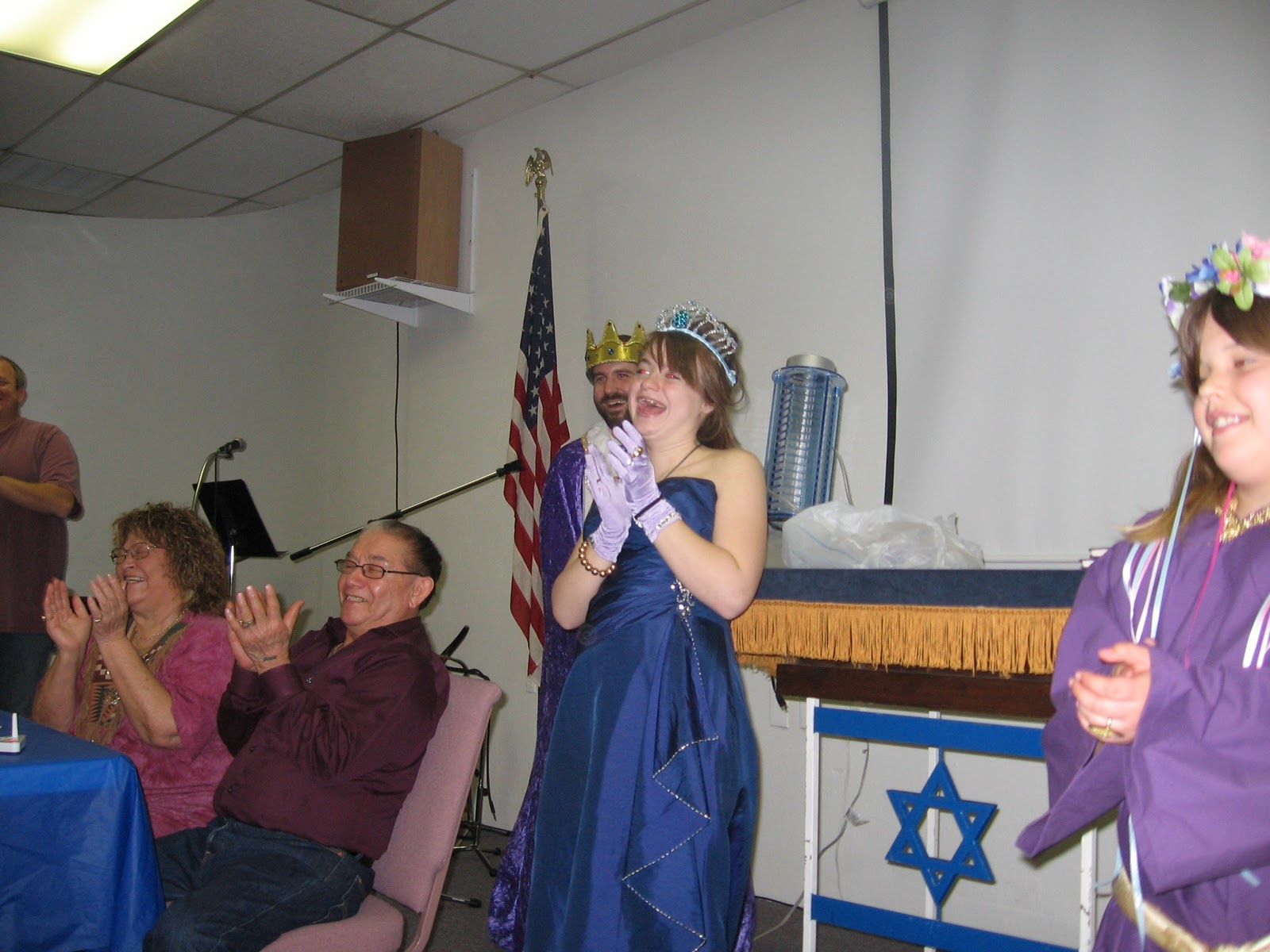
Judging the girls who dressed like Queen Esther in the costume contest!


Wednesday, March 09, 2011

Parasha: Vayikra "And He Called" Sacrificing the Self


Being a living sacrifice to God?  What does that mean and how can we do that in our lives? Read this weeks Drash from First Fruits of Zion to learn more. 
Vayikra - ויקרא : "And he called"
Torah : Leviticus 1:1-5:19
Haftarah : Isaiah 43:21-44:23
Gospel : Luke 1-3

Thought for the Week:

Does God need the sacrifices? Psalm 50 He declares that He is the owner of every beast and the cattle on a thousand hills. He says, "If I were hungry I would not tell you, for the world is Mine, and all it contains. Shall I eat the flesh of bulls or drink the blood of male goats?" (Psalm 50:12-13). He does not need sacrifices any more than He needs our prayers or our praise, but all three are things that He has enabled human beings to offer to Him so that they can enjoy relationship with Him.

Commentary:

He shall lay his hand on the head of the burnt offering, that it may be accepted for him to make atonement on his behalf. (Leviticus 1:4)
In Romans 12:1, Paul urges us to present our bodies as "living and holy sacrifice, acceptable to God." What does this mean in practical terms? Is Paul asking us to build altars and literally sacrifice ourselves upon them? Of course not. Paul is using the sacrificial language as an illustration for obedience. He is urging us to set aside our stubborn wills, our wayward flesh and our self-centered egos and force them to submit to the commandments of God. When we set aside our own personal desires and inclinations for the sake of obeying God, we are sacrificing ourselves for the sake of heaven. Instead of offering a bull, a goat or a lamb to God as a gift, we are offering ourselves. This is why the prophet Samuel declared that obedience is better than sacrifice:
Has the LORD as much delight in burnt offerings and sacrifices as in obeying the voice of the LORD? Behold, to obey is better than sacrifice, and to heed than the fat of rams. (1 Samuel 15:22)
Through the prophet Hosea, the LORD declared, "I delight in loyalty rather than sacrifice, and in the knowledge of God rather than burnt offerings" (Hosea 6:6). Yeshua was fond of quoting this verse to prove that God was more concerned with ethical behavior than perfunctory ritual obedience. This is an important principle for all religious people. The writer of the book of Hebrews says, "Do not neglect doing good and sharing, for with such sacrifices God is pleased" (Hebrews 13:16).
In today's world there is no Tabernacle or Temple in which a person might offer a sacrifice. If we desire to give God a gift today, what can we give Him? We can give no better gift than our own humble submission to His will. We can give Him the simple sacrifice of grateful obedience.
As the Torah describes the sacrificial service, it says that when the smoke of the offering rises to heaven, it will be a "soothing aroma to the LORD" (Leviticus 1:9). At first this seems strange. Does God really like the smell of burning meat?
Rashi interprets the "soothing aroma" as a metaphor for man's obedience. He explains that the aroma of the sacrifice is pleasing to the LORD because it is a token of His children's obedience. When God "smells" the aroma of the sacrifice, He says, "I have given commandments and my will has been obeyed."
In the same line of thought, the pleasing aroma of the sacrifice symbolizes God's acceptance of man's gift. When God "smells" the sacrifice, He delights in the human being who has gone to such effort to draw close to Him.

Wednesday, March 02, 2011

The Glory and the Tabernacle

This weeks Drash from First Fruits of Zion http://ffoz.org/resources/edrash/pekudei/the_glory_and_the_tabernacle.php


Pekudei : פקודי - "Accounts"
Torah : Exodus 38:21-40:38
Haftarah : I Kings 7:51-8:21
Gospel : John 6:1-71

Thought for the Week:

The paradox between the immanence of God and the transcendence of God paradox is illustrated in the mechanics of the Tabernacle. The uncontainable, inapproachable God is somehow contained (so to speak) within and maybe approached within a physical Tabernacle on Earth. The paradox between immanence and transcendence is also obvious in our sorry attempts to form a Christology which would explain the divine nature of Messiah. It is a mystery no less profound than the mystery of God taking up residence within the space of the Tabernacle. It would seem to be an impossibility; nonetheless, He did.

Commentary:

A sudden shout rose up through the assembly and all eyes were fixed upon the mountain. The cloud which had covered the top of the mountain these many days seemed to be descending. Yes, it was, rolling and cascading down the mountainside like a sudden avalanche of vapor, mist and smoke.
A panic spread through the people; a holy terror seized every heart. As if choreographed in advance, all Israel--every man, woman and child--fell prostrate to the ground. There was a brilliant light emanating from the cloud as it dropped from the top of Mount Sinai. The peak of the mountain was now visible, gleaming in the sun. Without the cloud covering it, it seemed to be a small, humble and insignificant mountain after all. The LORD had left Sinai.
Then the cloud covered the tent of meeting, and the glory of the LORD filled the tabernacle. Moses was not able to enter the tent of meeting because the cloud had settled on it, and the glory of the LORD filled the tabernacle. (Exodus 40:34-35)
God had taken up residence in the Tabernacle, but He was unapproachable. Even Moses, who was accustomed to standing upon Mount Sinai and basking in the glory of the presence of the LORD, could not enter. How is it, then, that Moses was able to withstand God's glory on Mount Sinai, yet was not able to enter into the Tabernacle?
When Moses ascended Sinai, he entered into the true Tabernacle, the very courts of God. Thus the glory of God on the mountain represents the glory of God in the World to Come and the New Covenant, whereas the glory of God in the Tabernacle is His glory in the this World and covenant. That is the reason Moses can approach on the mountain, but was unable to do so when the glory descends to the earth. The mountain symbolized the Heavenly reality. Thus even Yeshua had to veil His glory (except while on the mountain of transfiguration—a parallel to Sinai). His glory will only be fully revealed when the heavenly reality is fully realized on Earth. In that day, God's people will be able to approach the Glory without restriction, as John notes, "I saw no temple in it, for the Lord God the Almighty and the Lamb are its temple. And the city has no need of the sun or of the moon to shine on it, for the glory of God has illumined it, and its lamp is the Lamb." (Revelation 21:22-23)

Tuesday, March 01, 2011

Shema Israel

The Shema is a prayer that is said during our worship service at Beth Yeshua.  Instead of trying to explain it myself I will borrow from Aaron Eby from First Fruits of Zion.  Aaron has blogged all about the Shema.

His blog and the link to that blog can be found below.

I want to post the prayer here so that you can read it and also post a video of the prayer being sung so you can hear what it sounds like.  It is very beautiful.

Deuteronomy 6:4

Sh'ma Yis'ra'eil Adonai Eloheinu Adonai echad.
Hear, Israel, the Lord is our God, the Lord is One.
In an undertone:


Barukh sheim k'vod malkhuto l'olam va'ed.
Blessed be the Name of His glorious kingdom for ever and ever.


http://ffoz.org/blogs/2010/05/intro_to_the_shema_part_i.html


http://ffoz.org/blogs/2010/05/intro_to_the_shema_part_ii.html


The Siddur Project

Intro to the Shema (Part I)  

AARON EBY  MAY 7, 2010

One of the most well-known elements of Jewish prayer is the Shema. The Shema is a core part of the prayer services every day, in the morning and in the evening.
The Shema means much more to Judaism than simply a Scripture reading or a daily prayer. It is a summary of faith, mission, and identity all in one. It is often the first verse of the Bible that a Jewish child learns by heart. It is recited twice daily by faithful Jewish people for as long as they live. Many people, especially martyrs, utter the words of the Shema with their dying breath.
There is enough to say about this sequence of passages to fill volumes. I think the best approach for me in this blog is to begin with a basic overview. In later posts, perhaps I will focus in on more of the details. This will take some time, so please be patient!

Components of the Shema

The Shema is named for its first line, Deuteronomy 6:4, which says: "Hear, O Israel, the LORD is our God; the LORD is One." The word shema (שמע) means "hear" or "listen" and it is in the imperative form, that is, the command form. Shema can also have the sense of "obey," meaning that the one does not merely accept sounds passively into their ear but takes them seriously and carries them out.
The Shema is more than this first line, however. After Deuteronomy 6:4, a quiet response is added: "Blessed is the name of the glory of His kingdom forever and ever," (translations vary). Then the Shema continues with Deuteronomy 6:5-9, which gives us the commandment to love God "with all of your heart, and with all of your soul, and with all of your might," and continues to communicate the importance and value that we should place upon the Torah.
Next, a second passage is read: Deuteronomy 11:13-21. This passage echoes many of the terms in the first passage, but it is also different in some respects. Like the first passage, it speaks of hearing God, loving God and treating His words with importance and value. However, it continues by offering promises for proper observance and warnings for disobedience.
The third and final passage is from Numbers 15:37-41. This reading is very different from the other two. It describes the commandment to attach tzitziyot (tassels) to the four corners of the garments, and then concludes with a reminder of the Exodus from Egypt.

Questions

Clearly, these passages would not have been selected arbitrarily, since the Shema is considered so fundamental to Jewish thought. But if their selection and arrangement is intentional, several questions arise.
First, what makes the first reading so important that it should be included? Also, why is it placed first out of the three passages?
We can easily see the connection between the first and second readings. But if the second section repeats so many parts of the first section practically verbatim, why is it even necessary? It would appear that what makes it important are the differences, so what are those differences and what are their significance?
Since the first and second passages are so clearly connected, the third passage appears to be an odd one out. It is very different in content, and it even comes from a different book of the Torah. How is this passage connected to the others that would merit its inclusion? Also, why would it be placed at the very end of the reading?

Surrounding Blessings

Before we answer these questions, however, it should be noted that when the Shema is read as a part of the prayer service, it is surrounded by a sequence of blessings. While the content is a little different between the morning and the evening, the topic is the same each time.
The first blessing is one that acknowledges God as the Creator. In the evening, the blessing reads, "Blessed are You, O LORD, our God, King of the universe, who causes it to become evening with His word, opens gates with wisdom, changes times with discernment, changes the seasons, and orders the stars in their watches in the sky according to His will." It is an allusion to the creation narrative in the beginning of Genesis. In the morning, the blessing begins, "Blessed are You, O LORD, our God, King of the universe, who forms light and creates darkness, makes peace and creates all things," which is a direct allusion to Isaiah 45:7.
The second blessing focuses on the love relationship between God and Israel. In the evening it begins "With an eternal love You have loved the House of Israel, Your people." The morning version begins "You have loved us with an abundant love, O LORD, our God, and with very great pity you have pitied us." Both the morning and evening blessings identify the Torah as the expression of this love relationship.
After the Shema is read, a third blessing is recited that identifies God as Redeemer. Again, it is different in the morning and evening, but not as different as the previous two. It recounts the Exodus from Egypt, particularly the crossing of the Red Sea and the song the Israelites sang on the shore. In both versions, it ends, "Blessed are You, O LORD, who has redeemed Israel."
These blessings raise an additional question. What do the topics contained in these blessings have to do with the Shema?

A Natural Progression

Far from being a random assortment, a close examination of the three passages of the Shema reveals that they form a logical, natural progression of thought.
Examining the first passage, we can draw out three important themes:
·             God's Oneness: "The LORD is our God, the LORD is One..."
·             Love of God: "And you shall love the LORD, your God..."
·             Knowledge of God: "Teach them repeatedly to your children..."
In the second and third passages, the themes continue:
·             Obedience: "If you dutifully hear my commandments..."
·             Sanctification: "You will be holy for your God."

God's Oneness: Deserves Exclusive Worship

God's oneness can be understood in a few different ways. The immediate context of Deuteronomy provides a clear context for the Shema as a part of Moses' plea that the Israelites remain faithful to God. See how his statement "the LORD is One" is in the midst of a repeating refrain asking the Israelites not to commit idolatry.
·             To you it was shown that you might know that the LORD, He is God; there is no other besides Him. (Deuteronomy 4:35)
·             the LORD, He is God in heaven above and on the earth below; there is no other. (Deuteronomy 4:39)
·             I am the LORD your God who brought you out of the land of Egypt, out of the house of slavery. You shall have no other gods before Me. You shall not make for yourself an idol, or any likeness of what is in heaven above or on the earth beneath or in the water under the earth. You shall not worship them or serve them... (Deuteronomy 5:6-9)
·             Hear, O Israel, the LORD is our God; the LORD is One. (Deuteronomy 6:4)
·             You shall fear only the LORD your God; and you shall worship Him and swear by His name. You shall not follow other gods, any of the gods of the peoples who surround you..." (Deuteronomy 6:13-14)
Thus, we can see that one primary element of God's oneness is that he is deserving of exclusive worship.
Isaiah 45 makes direct allusions to the Shema and picks up on Deuteronomy's anthemic adjuration:
·             I am the LORD, and there is no other; Besides Me there is no God... (Isaiah 45:5)
·             ...And there is no other God besides Me, A righteous God and a Savior; There is none except Me. Turn to Me and be saved, all the ends of the earth; For I am God, and there is no other. (Isaiah 45:21-22)

God's Oneness: Ultimate Sovereignty

However, Isaiah 45 presents the oneness of God in another light. The verse cited in the blessing before the Shema teaches us that God is:
·             The One forming light and creating darkness, Causing well-being [peace] and creating calamity [evil]; I am the LORD who does all these. (Isaiah 45:5-7)
In other words, there is not a dualistic good god/bad god system as is taught by Zoroastrianism and other religions. Instead everything, good and bad, is under God's exclusive control. Thus, we learn that another aspect of God's oneness is that He does not share sovereignty with anyone else. He is exclusively sovereign.

But when Isaiah identifies God as Creator of all things, another idea is brought to mind. We see God as entirely independent from His creation. He is not contained in it or bound by it. Creation exists because He continues to make it exist. Our existence depends on Him, but His existence does not depend on anything. Thus, we see God as the ultimate, independent existence. Additionally, since God existed before all things and created everything, we can know that there is no other god whatsoever. God is independent and exclusive in His existence.

This answers our question about the first blessings before the Shema. We see that knowing God as Creator is an integral part of acknowledging His oneness.

The LORD is Our God

But there is another element in the statement of God's oneness that we have not addressed. That is the declaration that "the LORD is our God."
This statement identifies the God who chose Israel as the God who rules supreme over the entire world. No other nation is able to make that claim, because the relationship that the LORD initiated with Israel is unique.
Notice how the Ten Commandments (in Deuteronomy 5) form an immediate context for this line of the Shema (in Deuteronomy 6). Even the phrase "Hear O Israel" was previously stated in Deuteronomy 5:1. It should not be surprising, then, that the two passages bear a strong connection:
·             The LORD is our God / I am the LORD, your God
·             The LORD is One / You shall have no other gods before Me
The statement that "the LORD is our God" is a reference to the phrase that echoes throughout the Torah and the Prophets: "You will be My people, and I will be your God." This promise is formulated in covenantal terms, and evokes an image of Israel as a bride and God as a groom. The story of the giving of the Torah on Mount Sinai is presented as a betrothal or wedding. Thus, it follows that the Torah itself represents the love relationship between God and Israel, like aketubah (marriage contract) represents the union between a man and his wife.

To Be Continued...

In a later post, God willing, I will continue this discussion of the Shema by showing how the realization of God's oneness leads us into a love relationship with Him.
Aaron Eby
Rosh Chodesh Sivan 5767


The Siddur Project

Intro to the Shema (Part II)

MAY 14, 2010

This is the second in a series of posts about the Shema. See this post to read the first part.
This series is actually a part of a larger study of the traditional Jewish prayers. When describing the other main sections in the prayer service, I described how they can be compared to sections of the Temple, as if the person who offers the prayers is making a pilgrimage to that reaches all the way to the inner sanctuary of the Holy Place.
In these terms, the recital of the Shema as part of the entire service represents one who as actually entered into the central building of the Temple and stands in the Sanctuary, in the midst of the Golden Altar of Incense, the table with the Bread of the Presence and the seven-branched Menorah.
In the previous post, I posed some questions about the Shema: why were those particular readings selected, and why were they placed in this particular order?
I began to answer these questions by drawing out a sequence of themes that can be seen in the Shema readings:
·             God's Oneness: "The LORD is our God, the LORD is One..."
·             Love of God: "And you shall love the LORD, your God..."
·             Knowledge of God: "Teach them repeatedly to your children..."
·             Obedience: "If you dutifully hear my commandments..."
·             Sanctification: "You will be holy for your God."
While it may not be immediately apparent, I intend to show how these themes form a seamless and natural progression that is fundamental to biblical faith.

Recognition of God's Oneness

I have already explained how God's Oneness is best understood in terms of exclusivity. The LORD is exclusively deserving of worship, He is the sole Creator of all things, and He is independent and all-encompassing in His sovereignty.
Not only this, but God has identified Himself as the God of Israel. He has attached Himself in covenantal terms to a single people group out of all of the nations. Recognition of the fact that God is One (in the sense described above) should lead us to remain faithful and loyal to the covenant relationship. This fervent, active covenant loyalty and exclusive devotion is what is meant by "love."

Love and Covenant

People often describe love of God in terms of obedience to commandments. While the two are closely interconnected, mechanical observance is not an exact equivalent to love. Instead, love represents fierce and unquenchable devotion to the covenant relationship, which naturally expresses itself in terms of obedience and observance. This underlying motivation for obedience is essential because it is entirely possible to remain within the legal boundaries of the Torah and simultaneously inwardly corrupt. (The commentator Ramban referred to this condition as naval birshut hatorah, "corrupt with the permission of the Torah.")
Our text describes our expression of love for God in three ways: with all of our heart (levav), with all of our soul (nefesh) and with all of our might (me'od). These terms can be misleading if the English translation is taken at face value, so they merit some explanation.

With All Of Your Heart

In the English speaking world, one's heart symbolically represents a person's center of emotion, desire and affection. Biblically, this is not the case. Emotions are found in the kidneys (kelayot) or bowels (me'ah), which are often translated "innermost being" or "inward parts" to avoid sounding distractingly weird to English speakers.
Symbolically speaking, the heart has a more specific function of making decisions. It represents one's will and thoughts. It is the place where one forms ideas, intentions and plans. Often, it could safely be translated "mind," since it represents a similar general concept. The heart represents in the Hebrew Scriptures the location of what is spoken of by the Apostles as "flesh" vs. "spirit," and what later Jewish thought terms the "evil inclination" (yetzer hara) and the "good inclination" (yetzer hatov).
This explains the meaning of idioms such as "written upon one's heart," which means that something is an intrinsic part of one's thought process, decision making and will.
In these terms, to love God with all of one's heart means to engage the core of one's will and mind in loyalty to the covenant between God and Israel. One who does so will make decisions based on that covenant and seek to submit his or her will entirely to God. Not only will one be outwardly dedicated to service of God, but this service will be internally motivated. Such a person will not allow his or her flesh (i.e., evil inclination) to dominate, but will walk according to the spirit.
Without doubt, this type of love of God was exhibited without restraint by our Master Yeshua, who submitted His will to the Father's will in every moment!

With All Of Your Soul

While the concept of "soul" is highly developed in later Judaism, in terms of the Torah it is quite simply one's self, and specifically the part of a person that animates them or makes them alive. Rather than an otherworldly or abstract love that the English word "soul" might imply, the Hebrew text should be understand as loving God with one's life; this means an active love that is manifest in the physical world.
A person who loves God with his or her soul will not be satisfied with merely holding good intentions or affectionate thoughts, but his or her covenant devotion will be expressed in every action, every breath and heartbeat. The most mundane acts of life will be considered an act of worship.
Rabbi Akiva (second century) interpreted "love the LORD...with all of your soul" to mean you should love God even if your soul--that is, your life--is taken from you. In his days, the oppressive Roman government outlawed the study and teaching of Torah. Rabbi Akiva did not comply; he brazenly continued to hold public Torah classes. Eventually, he was brutally tortured to death by the Romans and uttered the Shema as his own soul departed.
Becoming a martyr for the sake of Heaven is called in Hebrew Kiddush Hashem, sanctification of God's name. By giving up one's life for God's sake, one brings holiness into the world and sanctifies God's name.
We love God with our heart because we recognize God as our source of blessing. That type of love is the kind of love that one who receives shows to one who gives. God only gives; He does not receive anything because He does not lack anything. We receive His goodness, and this is a source of our love for Him.
But a greater level of love occurs between one giver and another giver. One who is a giver acts in imitation of God and therefore bears a greater level of closeness to Him. By imitating Him, we express a Father-child relationship with God. For example, Yeshua said, "Blessed are the peacemakers, for they shall be called sons of God." They are called "sons of God" precisely because they are doing what God does. To imitate God is to participate in Father-child love.
When someone sanctifies God's name and loves God with their soul by giving it up for His sake, they are no longer receivers but are givers, in that they give holiness to the world through their deed. And in being givers, they are emulating the works of their Father who is in heaven.
No surprise, then, that Yeshua, who is God's unique Son, would become the giver to all mankind through His death (and in His resurrection). Our Master also "poured out his soul (nefesh) to death" (Isaiah 53:12), exhibiting love for God in ultimate terms.
When we declare that we must love the LORD with our soul, we must resolve that if circumstances arose that standing firm in our faith and devotion to God meant death at the hands of man (Heaven forbid), that we would be willing to offer our lives in that moment. According to Jewish Law, God reckons sincere good intention as an actual deed. And so when we resolve to stand for God to the death, God reckons it as if we had actually done so.
According to Rabbi Shimon Schwab, this is the meaning of the passage in Psalms 44:20-22:
If we had forgotten the name of our God 
Or extended our hands to a strange god, 
Would not God find this out? 
For He knows the secrets of the heart. 
But for Your sake we are killed all day long; 
We are considered as sheep to be slaughtered.
Because of our resolve to love God with even our souls, it is as if "for Your sake we are killed all day long."
This sentiment seems to echo the words of the Master when He said to His disciples, "If anyone wishes to come after Me, he must deny himself, and take up his cross daily and follow Me." It also reflects the sentiments of Paul, "I die daily," and "I have been crucified with Christ." Paul even makes direct allusion to this passage when he says:
Who will separate us from the love of Christ? Will tribulation, or distress, or persecution, or famine, or nakedness, or peril, or sword? Just as it is written, "FOR YOUR SAKE WE ARE BEING PUT TO DEATH ALL DAY LONG; WE WERE CONSIDERED AS SHEEP TO BE SLAUGHTERED." (Romans 8:35-36 NASB)

With All Of Your Might

This is perhaps the most difficult phrase of the three to render in proper English. There are numerous Hebrew words that could easily be translated "might," but me'od would not be on the top of the list! The word me'od is not normally even a noun; it is an adverb that is typically translated, "very, exceedingly, greatly." For example, the phrase "very good" in Hebrew is literallytov me'od (in reverse order: "good very").
If we were mechanically to translate me'od this way in the Shema, it would result in "You shall love the LORD...with all of your very." This, of course, is unacceptable English and does not convey a clear meaning. But one's me'od could be understood as that which makes a person great. Perhaps one way to think of it is "with all of your greatness."
One might be tempted by our English translations to understand this in terms of muscles or physical effort. However, this word has been interpreted from ancient times to refer to one's resources, monetary and otherwise. Targum Onkelos (an ancient translation) renders this word with the Aramaic term nichsach, which can mean "property, goods, flocks or wealth."
This interpretation is different enough from standard Christian interpretation to raise suspicions, but in light of the teaching of the Gospels it makes perfect sense.
And someone came to Him and said, "Teacher, what good thing shall I do that I may obtain eternal life?" And He said to him, "Why are you asking Me about what is good? There is only One who is good; but if you wish to enter into life, keep the commandments." Then he said to Him, "Which ones?" And Jesus said, "YOU SHALL NOT COMMIT MURDER; YOU SHALL NOT COMMIT ADULTERY; YOU SHALL NOT STEAL; YOU SHALL NOT BEAR FALSE WITNESS; HONOR YOUR FATHER AND MOTHER; and YOU SHALL LOVE YOUR NEIGHBOR AS YOURSELF." The young man said to Him, "All these things I have kept; what am I still lacking?" Jesus said to him, "If you wish to be complete, go and sell your possessions and give to the poor, and you will have treasure in heaven; and come, follow Me." But when the young man heard this statement, he went away grieving; for he was one who owned much property. (Matthew 19:16-22 NASB)
This passage from Matthew raises an interesting question. Our Master is famous for summarizing the Torah using the combination "love God" and "love your neighbor." However, in this instance He employs the second passage, but instead of saying "love God," He lists a number of specific commandments. Why?
Yeshua, aware that the young man was wealthy, might have purposely avoided the commandment to "love God" so that the man could answer affirmatively to His first challenge without any dispute. But when presented with the challenge to devote his wealth to God, it became clear that he failed to "love God with all."
An opposite situation occurs in the story of the poor widow:
And He looked up and saw the rich putting their gifts into the treasury. And He saw a poor widow putting in two small copper coins. And He said, "Truly I say to you, this poor widow put in more than all of them; for they all out of their surplus put into the offering; but she out of her poverty put in all that she had to live on." (Luke 21:1-3 NASB)
Clearly, the idea that we must love God by devoting all of our material resources to Him is in direct line with the Messiah's teachings.
Sages have noted that these dimensions of love for God are in an increasing order of difficulty. The easiest thing is to love God with one's heart. It is more difficult to love God even to the point of sacrificing one's life. But what could be more difficult than that?
It is a trustworthy saying, "It is easier to die for God than to live for Him." Thankfully, most people are never given the opportunity to test their faith at that extreme level. However, we are given a more difficult challenge: to remain alive, and yet submit ourselves on every level to God.
With God's help, this series will continue by exploring the relationship between love of God and knowledge of Him.
Aaron Eby
Sivan 17, 5767
About the Author: Aaron Eby writes for messiah magazine and other FFOZ publications. He is also the author of the forthcoming Siddur, as well as the recently published Hebrew lesson DVD.